
Strategy
Shopify Mobile App vs Mobile Website: What Should Your Store Choose in 2026?
Updated October 5, 2026 • 11 min read
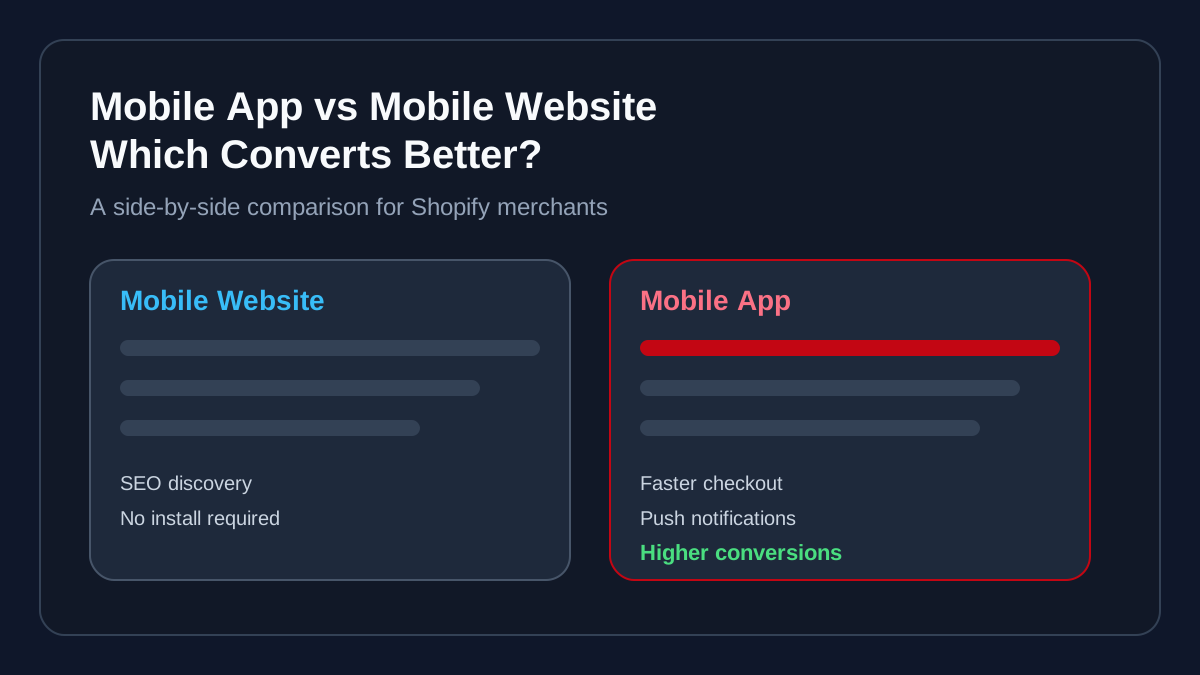
If you run a Shopify store, there is a good chance that most of your customers already visit your store from their phones.
So a reasonable question is: why would you build a mobile app when your Shopify website already works on mobile?
It’s a fair question. A good mobile website can already provide a great shopping experience. Customers don’t need to download anything, they can discover your store through Google, social media or ads, and Shopify takes care of a lot of the technical work.
But a mobile app solves a different problem.
A website is very good at bringing customers to your store. An app can be much better at bringing existing customers back.
That difference is becoming increasingly important as Shopify merchants focus more on retention, repeat purchases and customer lifetime value.
So, which one should you choose in 2026? The answer depends on your business.
Mobile website vs mobile app: what’s the difference?
A mobile website is simply your Shopify store optimized for a phone. Customers open your store through Safari, Chrome or another browser. They don’t need to install anything.
A mobile app is a dedicated iOS or Android shopping experience connected to your Shopify store. Customers install the app and can return to it directly from their phone.
The important difference isn’t just how the store looks. It’s what you can do after the customer leaves.
With a website, you generally have to convince the customer to come back through ads, email, social media, search or other marketing channels.
With an app, you have another direct channel to an opted-in customer through things like push notifications, personalized offers and app-specific experiences.
Mobile website: where it still wins
Let’s be clear: a mobile website isn’t going away. For many Shopify merchants, it is still the right choice.
1. Customers don’t need to install anything
This is probably the biggest advantage. Someone clicks your Instagram ad, Google result or shared product link and immediately reaches your store.
There is no “Download our app first.” That extra step can create friction, especially when someone is discovering your brand for the first time.
2. Better for customer acquisition
If your business depends heavily on SEO, Google Ads, Meta Ads, influencer traffic or social media, your website is still extremely important.
A customer can discover a product and purchase it without ever knowing that your app exists.
3. Easier to maintain
Your Shopify store is already your main commerce platform. You change the product. You update the price. You add inventory. You change the theme. Your mobile website reflects those changes automatically.
You don’t have to think about maintaining two separate native applications.
4. Better for low-frequency purchases
Think about a customer buying a sofa. They might purchase from you once every few years. There isn’t much reason for them to keep your app on their phone.
For businesses with low purchase frequency, a strong mobile website may provide a better return than investing heavily in an app.
Where a mobile app starts to make sense
Now consider a different type of business. A customer buys skincare every month. Or clothing every few weeks. Or snacks, supplements or beauty products. Or they regularly check new product drops.
That’s where the conversation changes. The merchant doesn’t only need to acquire the customer. They need to bring the customer back. And that’s where an app can become interesting.
1. Push notifications
This is one of the biggest differences between a mobile app and a mobile website. An app can send notifications directly to customers who have opted in. For example:
- “Your favourite product is back in stock.”
- “Your cart is still waiting.”
- “New collection just dropped.”
- “Your usual order is probably running low.”
The important part is not simply sending more notifications. It is sending useful notifications at the right time.
A merchant sending five generic promotional messages every week may annoy customers. A merchant sending a relevant notification when something the customer actually wants happens can create a reason to open the app. For a practical example, see recovering Shopify carts with app push notifications.
2. A better experience for repeat customers
A first-time customer and a returning customer don’t necessarily need the same experience. A new visitor might need:
- Product discovery
- Reviews
- Brand information
- Education
- Offers
A returning customer might want:
- Recently viewed products
- Previous orders
- Faster checkout
- Reordering
- Wishlist
- Personalized recommendations
- Loyalty rewards
A mobile app gives merchants more room to build an experience around the returning customer. That’s one reason apps can be particularly interesting for brands with strong repeat purchase behaviour.
3. Faster access to your store
Think about how people use apps on their phones. They don’t type a URL every time they want to open Instagram. They don’t search Google every time they want to open Amazon. The app is simply there.
That doesn’t mean your Shopify store suddenly becomes Amazon because you launch an app. But it does remove one step between the customer and your store. For a customer who already likes your brand, that convenience can matter.
4. Personalization
This is another area where the market is moving. Mobile commerce is increasingly becoming less about showing everyone the exact same storefront.
Imagine opening an app and seeing “Welcome back, Sarah.” Then:
- Your recently viewed products
- Products similar to previous purchases
- Your loyalty points
- A personalized offer
- Your last order
- Products that are back in stock
That is a very different experience from simply opening a generic mobile website.
Personalization is likely to become one of the more important areas of mobile commerce as AI and customer data become more deeply integrated into shopping experiences.
5. Loyalty and retention
This is probably the biggest strategic reason to consider an app.
Don’t build an app just because “our competitors have one.” Build one if you have a reason for customers to come back. That reason could be:
- Loyalty rewards
- Early access
- New product drops
- Exclusive products
- Personalized offers
- Faster reordering
- Membership benefits
- Push notifications
- Live shopping
- Personalized recommendations
The app itself isn’t the retention strategy. The experience inside the app is.
Mobile app vs mobile website: quick comparison
| Feature | Mobile website | Mobile app |
|---|---|---|
| No installation | ✅ | ❌ |
| Easy to discover through Google | ✅ | Limited |
| Works from social links | ✅ | Limited |
| Push notifications | ❌ | ✅ |
| Direct access from home screen | ❌ | ✅ |
| Personalized app experience | Limited | ✅ |
| Loyalty features | Possible | Strong |
| Repeat purchase experience | Good | Strong |
| Reordering | Good | Excellent potential |
| App-exclusive experiences | ❌ | ✅ |
| Development effort | Lower | Higher |
| Best for | Discovery | Retention |
This table also shows why the answer isn’t simply “apps are better.” They solve different problems.
What about PWAs?
Progressive Web Apps, or PWAs, sit somewhere between the two. A PWA attempts to make a website behave more like an application. Depending on the implementation and platform, PWAs can offer things such as:
- App-like navigation
- Faster loading
- Offline capabilities
- Home-screen installation
- Improved mobile experiences
They can be an interesting option for merchants who want an app-like experience without immediately building traditional native iOS and Android applications.
But they don’t automatically replace native apps. If your strategy depends heavily on native mobile capabilities, app-store distribution, deep engagement or sophisticated mobile retention features, a native app may still make more sense. More detail in Shopify mobile app vs PWA.
How much does a mobile app actually cost?
This is where things get interesting. There isn’t one price. The cost depends heavily on how you build it.
Option 1: Build it yourself
A technically capable team can build a Shopify-connected mobile app using React Native, Flutter or native iOS/Android development. The software cost may look manageable. The engineering cost is not. You have to think about:
- iOS and Android development
- Shopify APIs
- Authentication
- Product synchronization
- Cart and checkout
- Push notifications
- Analytics
- App Store and Google Play submission
- Backend infrastructure
- Bug fixing, updates and maintenance
For a merchant, this can quickly become a significant investment.
Option 2: Hire an agency
An agency can handle the development and app-store submission. This reduces the technical burden but increases the upfront cost.
The actual price can range from several thousand dollars to tens of thousands depending on the complexity and whether the app is custom-built.
Option 3: Use a Shopify mobile app builder
This is where platforms such as Tapcart, Shopney, Superfans, MageNative, OneMobile, Appbrew, SimiCart and Appziot come in. Instead of building everything from scratch, the merchant uses an existing platform connected to Shopify. We compare them in top 10 Shopify mobile app builders to consider in 2026.
The trade-off is usually straightforward: lower development cost and faster launch, but recurring platform fees and less control than a completely custom application.
For many Shopify merchants, this is the most practical way to test whether mobile apps can generate meaningful incremental revenue. For a full price breakdown, see how much a Shopify mobile app costs in 2026.
So, which is better in 2026?
There isn’t a universal answer. But there is a useful way to think about it.
Choose a mobile website if:
- Your store is still acquiring its first customers.
- Your products are purchased infrequently.
- Most of your traffic comes from Google and social media.
- You don’t have a strong retention strategy yet.
- You’re still validating product-market fit.
In these cases, spending heavily on a mobile app may be premature.
Consider a mobile app if:
- A meaningful percentage of your customers purchase repeatedly.
- You have strong customer retention.
- You have a loyalty program.
- You regularly launch new products.
- You want to build a direct communication channel with customers.
- Push notifications could meaningfully contribute to revenue.
- You want to create app-exclusive experiences.
- Your mobile traffic is already significant.
In these cases, an app deserves a serious business case.
What is changing in 2026?
The mobile commerce market is moving beyond the simple idea of “put my Shopify store inside an app.” That used to be the main selling point. It isn’t enough anymore.
The more interesting direction is: mobile app + personalization + AI + retention + loyalty + first-party customer relationships.
The best mobile apps won’t simply copy the website. They’ll give customers a reason to open them. That’s an important distinction.
If your app opens to the exact same homepage your customer sees on your website, with the exact same products and the exact same experience, you should ask yourself: why would the customer install it?
That’s the question merchants should answer before spending money on an app.
The simple decision framework
If you’re a Shopify merchant trying to decide what to build, start here:
- Mostly new customers? Focus on your mobile website.
- Mostly repeat customers? Start looking seriously at a mobile app.
- High mobile traffic but weak retention? Fix the customer experience first, then evaluate an app.
- Strong loyalty program and repeat purchases? A mobile app could be a powerful additional channel.
- Large DTC brand with significant mobile revenue? Look at mature mobile commerce platforms with advanced personalization, analytics and integrations.
- Growing Shopify brand with limited development resources? A mobile app builder can be a much lower-risk way to test the channel.
The bottom line
A mobile website and a mobile app aren’t really competing products. They do different jobs.
Your mobile website is your storefront for discovery and acquisition. Your mobile app can become a retention and engagement channel for customers who already know your brand.
For most Shopify merchants, the website should come first. But once repeat purchases, customer lifetime value and retention become important parts of the business, a mobile app becomes much more interesting.
And in 2026, the question isn’t really “Should I have a mobile app?” It’s: “Can I give customers a better reason to come back through an app than they currently have through my website?”
If the answer is yes, then it’s probably time to start evaluating one.
Frequently asked questions
Is a mobile app better than a mobile website for a Shopify store?
Not automatically. They do different jobs. A mobile website is better for discovery and acquisition through Google, ads and social links. A mobile app is better for bringing existing customers back through push notifications, personalization and loyalty features.
When should a Shopify store build a mobile app?
When a meaningful share of customers purchase repeatedly, mobile traffic is already significant, and you have a reason for customers to come back, such as loyalty rewards, product drops or reordering. If you are still finding your first customers, focus on the website first.
Can a PWA replace a native Shopify mobile app?
Not always. A PWA can offer app-like navigation, faster loading and home-screen installation, but if your strategy depends on native capabilities, app-store distribution or deeper retention features, a native app may still make more sense.
What is the cheapest way to launch a Shopify mobile app?
For most merchants, a Shopify mobile app builder. It has a lower development cost and faster launch than building in-house or hiring an agency, in exchange for recurring platform fees and less control than a fully custom app.