
Comparisons
5 Best Tapcart Alternatives for Shopify Stores
October 14, 2026 • 12 min read
Answer in brief
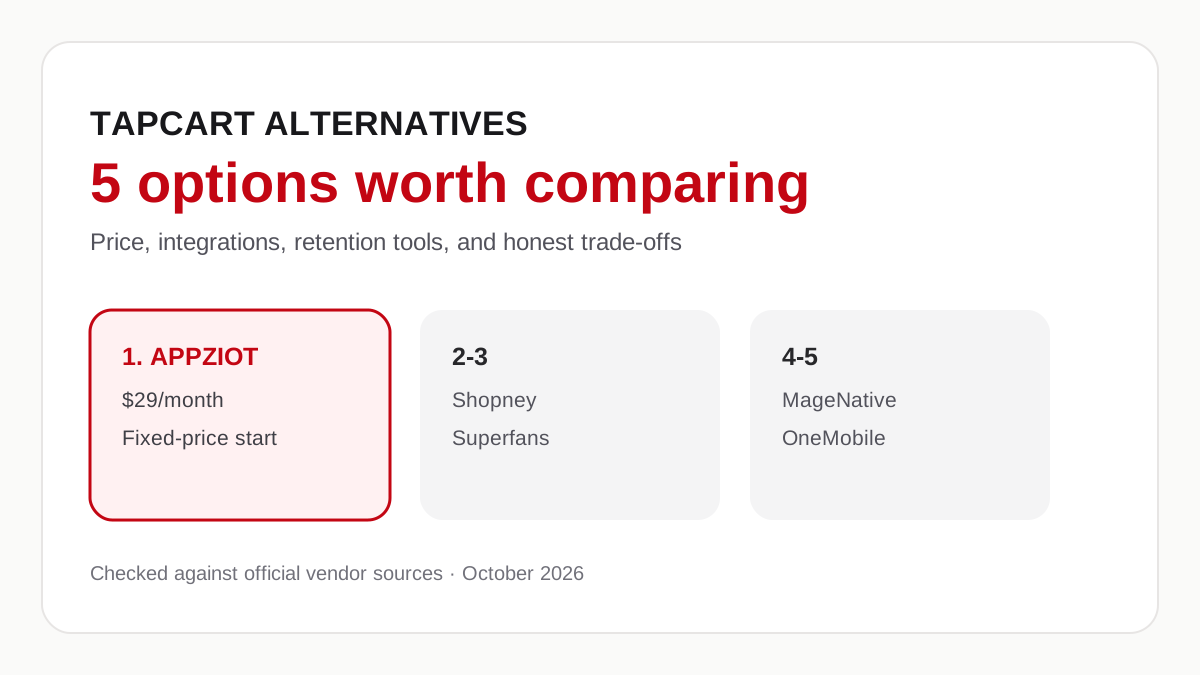
The strongest Tapcart alternative depends on why you are switching: Appziot for a lower fixed starting price, Shopney for integrations, Superfans for community-led retention, MageNative for international features, or OneMobile for low-upfront-cost experimentation. Keep Tapcart if your team will use its advanced testing and enterprise tools.
Tapcart is a capable Shopify mobile app platform. It is also a substantial commitment: its current public plans start at $500 per month, with Scale at $1,250 and Enterprise+ from $2,850. If your team will use its testing, targeting, analytics, and enterprise tooling, that investment may be reasonable. If you mainly need a branded iOS and Android app, Shopify sync, and push notifications, it makes sense to compare less expensive options.
Disclosure: This article is published by Appziot, and Appziot is listed first. That is a commercial conflict, so here is the honest version: Appziot has the lowest published fixed starting price in this group, but it has a shorter public track record and a smaller documented integration catalog than the established platforms below. We did not independently performance-test these products.
Prices and features were checked against official vendor pages and Shopify App Store listings on October 14, 2026. They can change, so confirm the final quote and contract before buying.
The short answer
| Alternative | Published starting price | Best fit | Main trade-off |
|---|---|---|---|
| Appziot | $29/month | A lower-cost fixed-price launch | Smaller documented integration catalog |
| Shopney | $149/month | Broad integrations and localization | Advanced features move to higher tiers |
| Superfans | $150/month on Shopify listing | Community and retention-led apps | Large jump to the $1,000 Unlimited plan |
| MageNative | $99/month | International stores and a conventional feature ladder | Entry plan limits push volume |
| OneMobile | Free; paid from $99/month | Low-upfront-cost experimentation | Paid plans add revenue-linked infrastructure fees |
What Tapcart still does well
Tapcart is not a product merchants should leave simply because a cheaper subscription exists. Growth includes unlimited blocks, integrations, push notifications, and custom screens. Scale adds tools that a serious optimization team can use: A/B testing, conditional content, heatmaps, and more advanced analytics. Enterprise+ adds developer tooling, regional apps, dedicated infrastructure, and a published 99.99% uptime SLA.
The question is whether your team will use those capabilities. Paying for experimentation software is sensible when somebody owns the experiments. It is harder to justify when the real plan is to publish products, update the home screen, and send a few thoughtful pushes each month.
Tapcart currently lists Growth at $500 per month, Scale at $1,250, and Enterprise+ from $2,850. Its Shopify listing also warns that external charges may apply, while the public pricing page does not provide one universal usage-fee formula. Ask for a written total covering the subscription, add-ons, usage or success fees, and professional services.
1. Appziot: best for a lower-cost fixed-price start
We put Appziot first because this is Appziot’s site—not because it wins every category. The clearest reason to shortlist it is price. Lite costs $29 per month or $290 per year. Starter is $99 per month or $990 per year, and Growth is $199 per month or $1,990 per year. Every plan has a 30-day trial.
Appziot creates native iOS and Android apps connected to a Shopify catalog. Lite covers a branded app, catalog and inventory sync, and analytics. Starter is the more realistic comparison for merchants leaving Tapcart because it adds the visual builder and push notifications. Growth adds richer push options, more widgets, branding removal, and priority support.
Why choose it over Tapcart: You need the core mobile shopping experience without a $500 monthly starting point, and you prefer a simple published price while proving whether customers will install and return to an app.
Where Tapcart is stronger: Tapcart publishes a broader integration ecosystem and more advanced experimentation, analytics, personalization, and enterprise controls. Appziot’s public integration page currently names a much smaller set. Appziot also has less public marketplace history.
See Appziot pricing or read the direct Tapcart vs Appziot comparison.
2. Shopney: best for integrations without revenue commission
Shopney is a mature Shopify-focused option with four plans. Silver is $149 per month, Gold is $299, Platinum is $599, and Enterprise starts at $1,299. Its site also publishes discounted annual rates and a 30-day trial.
Silver includes native apps, unlimited push notifications, in-app chat, and real-time Shopify sync. Gold adds abandoned-cart notifications, search and review integrations, and multilingual or multicurrency integrations. Platinum is where loyalty, subscriptions, segmented or AI push, AR, live selling, Klaviyo, Rebuy, and Nosto appear.
Why choose it over Tapcart: You want a broad Shopify integration catalog and flat subscription pricing without an advertised sales commission, but do not need Tapcart’s Scale-level testing tools.
Watch before signing: Build a list of the Shopify apps your store cannot operate without. Shopney may support them, but the required plan can materially change the price.
3. Superfans: best for community and retention experiences
Superfans, formerly Vajro, aims to make an app more than a smaller version of a storefront. Its public material emphasizes app-only drops, community feeds, shoppable user-generated content, games, polls, personalization, live selling, and retention campaigns.
The Shopify App Store lists Starter at $150 per month and Unlimited at $1,000 per month or $10,000 per year, with a 30-day trial. Superfans’ own pricing page emphasizes the Unlimited offer, so ask the company to confirm whether Starter is available and exactly what it includes.
Why choose it over Tapcart: Community, loyalty, gamification, and launch experiences are central to the app strategy, and your team wants hands-on support around those programs.
Watch before signing: The jump to Unlimited is large. Get the integration list, development scope, and feature access for your actual plan in writing.
4. MageNative: best for international features at a mid-market price
MageNative starts at $99 per month, followed by Standard at $149 and Premium at $249. It publishes annual totals, a 30-day trial, and a 0% success fee. Its product has been listed on Shopify since 2017, giving it a longer public history than several newer alternatives.
Its strongest case is the breadth between entry-level and enterprise pricing. Standard adds automated notifications, multilingual and multicurrency support, landing pages, and a success manager. Premium adds unlimited and segmented push, advanced analytics, AR, Shop Pay, and custom fonts.
Why choose it over Tapcart: You need localization or a broader ecommerce feature set but do not need Tapcart’s enterprise experimentation stack.
Watch before signing: Starter is limited to five instant pushes per month, and some feature counts differ across MageNative’s own pages. Confirm the exact plan matrix.
5. OneMobile: best for experimenting with minimal upfront cost
OneMobile offers a free tier, then ScaleUp at $99 per month, BrandUp at $299, and Omni at $990. It combines AI-assisted design with native app publishing, push notifications, multilingual support, shoppable video, voice or barcode search, and progressively more implementation support.
The important detail is the fee model. Paid plans add infrastructure fees after monthly app revenue crosses a threshold: 2.9% above $2,000 on ScaleUp, 1.9% above $10,000 on BrandUp, and 1.2% above $100,000 on Omni, each with a published monthly cap.
Why choose it over Tapcart: You want to prototype with almost no subscription commitment or value assisted publishing and AI design tools.
Watch before signing: Model the infrastructure fee using realistic app revenue. Also confirm whether the app will use your Apple and Google developer accounts, who controls the listings, and what an eventual transfer involves.
How to choose without regretting the switch
Do not start with a feature spreadsheet containing 80 checkmarks. Start with the five jobs the app must perform in its first six months.
- Write down the Shopify apps that must work inside the mobile experience.
- Build the same home screen and collection journey in each serious candidate.
- Test search, variants, discount behavior, customer login, cart, and checkout on a real phone.
- Ask for the complete first-year cost, including usage fees, setup, integrations, and Apple or Google accounts.
- Decide who on your team will update the app and send pushes after launch.
A cheap builder that breaks a must-have subscription flow is expensive. An enterprise platform whose analytics nobody opens is also expensive. The right alternative is the one whose daily workflow and total cost match the team you actually have.
Our practical verdict
Choose Appziot when a low fixed price and core native Shopify experience matter most. Choose Shopney for its mature integration ladder, Superfans for community-led retention, MageNative for international capabilities at a mid-market price, and OneMobile for low-upfront-cost experimentation. Keep Tapcart when your team genuinely needs its optimization and enterprise tools.
Sources
Frequently asked questions
What is the best lower-cost alternative to Tapcart?
Appziot has the lowest published fixed starting price in this comparison, but the best value depends on required integrations and features. MageNative and Shopney have broader published feature ladders, while OneMobile has a free entry point with variable fees on paid plans.
How much does Tapcart cost?
Tapcart’s public pricing page listed Growth at $500 per month, Scale at $1,250 per month, and Enterprise+ from $2,850 per month when checked on October 14, 2026. Ask for a written quote covering add-ons and any usage or success fees.
Can I move an existing mobile app away from Tapcart?
Usually, but migration is not a one-click copy. Confirm ownership of the Apple and Google listings, rebuild screens and integrations in the new platform, test customer flows, and coordinate the store updates so existing users receive the replacement version.
Should a small Shopify store build an app?
Not automatically. A mobile app is easier to justify when you already have repeat customers, meaningful mobile traffic, and a clear plan for bringing customers back. A good mobile website may be the better first investment for a new store.