
Comparisons
5 Best Shopney Alternatives for Shopify Stores
October 14, 2026 • 11 min read
Answer in brief
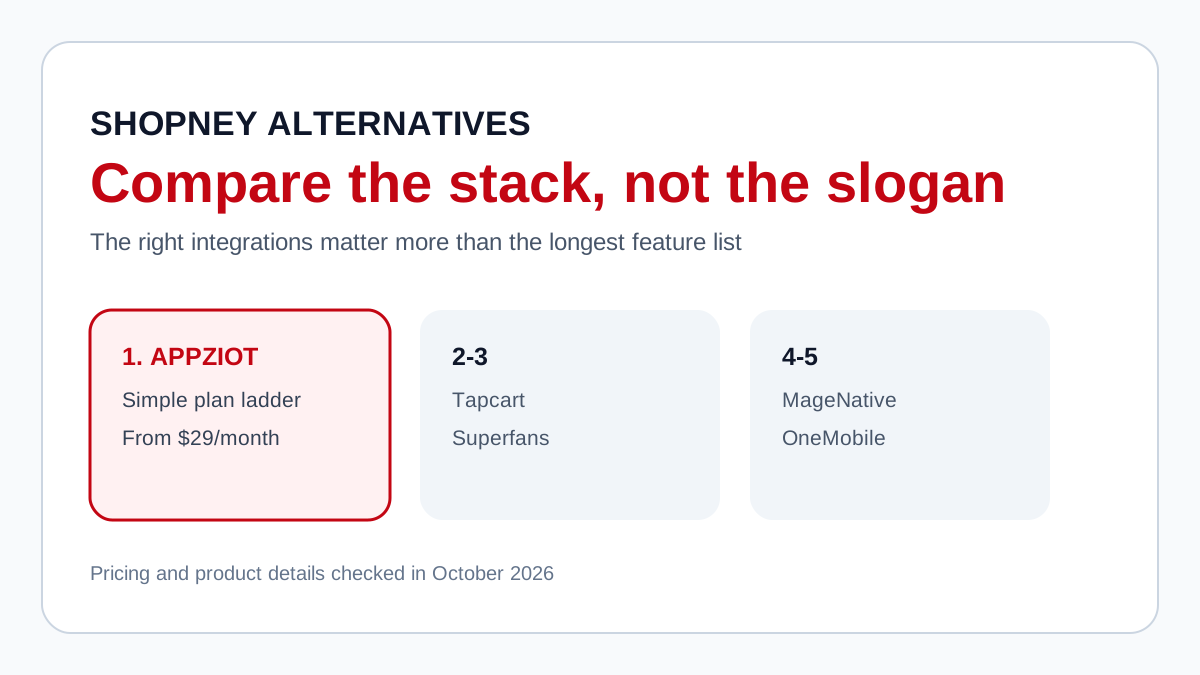
Appziot is the practical Shopney alternative for a lower fixed cost and simpler app. Tapcart suits advanced growth teams, Superfans focuses on community, MageNative offers international features at a mid-market price, and OneMobile lowers upfront cost with variable fees. Keep Shopney when its integration ecosystem matches your store.
Shopney is easy to shortlist for good reasons. It is focused on Shopify, publishes four clear tiers, offers unlimited push from its entry plan, and says it does not take a commission on app sales. Its integration catalog is also much deeper than many low-cost builders.
The case for an alternative usually comes down to one of three things: Silver still costs more than you want to spend, a must-have feature sits on Gold or Platinum, or your app strategy needs something Shopney is not centered around.
Disclosure: Appziot publishes this page and is placed first. Appziot is less expensive, but it does not match Shopney’s documented integration breadth or operating history. We used official public sources and did not independently benchmark app speed, reliability, or conversion.
Prices were checked on October 14, 2026 and can change.
Quick comparison
| Alternative | Published starting price | Strongest reason to consider it | Main compromise |
|---|---|---|---|
| Appziot | $29/month | Simple fixed-price native app | Smaller documented integration set |
| Tapcart | $500/month | Testing, analytics, and enterprise tooling | Far higher entry cost |
| Superfans | $150/month on Shopify listing | Community, UGC, and retention programs | $1,000 Unlimited tier |
| MageNative | $99/month | Localization and broad mid-market features | Limited push on lower plans |
| OneMobile | Free; paid from $99/month | Free prototyping and AI-assisted design | Revenue-linked fees on paid plans |
What you are comparing against
Shopney Silver is $149 per month. Gold is $299, Platinum is $599, and Enterprise starts at $1,299. Discounted annual rates are published, and every tier has a 30-day trial. Apple and Google developer accounts are separate expenses.
Silver includes native apps, unlimited push notifications, back-in-stock messages, in-app chat, and Shopify sync. Gold introduces abandoned-cart notifications, review and search integrations, and localization integrations. Platinum adds segmented and AI push, subscriptions, loyalty, live selling, AR, and several larger marketing integrations.
That structure is useful because a merchant can see the upgrade path. It can also become expensive when two or three required integrations sit on Platinum. Before switching, ask Shopney which plan supports your precise stack; the answer may be cheaper than a migration.
1. Appziot: best for keeping the first-year commitment low
Appziot’s Lite plan is $29 per month or $290 per year. Starter is $99 per month or $990 per year, and Growth is $199 per month or $1,990 per year. All three include a 30-day trial.
For a serious Shopney comparison, Starter is the relevant plan because it includes the visual builder and push notifications. Growth adds rich push, more widgets, the ability to remove Appziot branding, and priority support.
Choose Appziot when: Your app needs the core shopping journey, Shopify catalog sync, branding, and push, but not Shopney’s extensive catalog of loyalty, subscription, search, localization, and marketing integrations.
Choose Shopney instead when: Your current app stack already depends on several integrations Shopney publicly supports. Replacing those workflows can cost more than the subscription saving.
See Appziot plans and Shopney vs Appziot.
2. Tapcart: best for a dedicated mobile growth team
Tapcart is not the budget alternative. Growth is $500 per month, Scale is $1,250, and Enterprise+ begins at $2,850. It belongs in this comparison because some merchants outgrow Shopney in the opposite direction: they want more structured experimentation and enterprise controls.
Growth includes unlimited blocks, integrations, push, and custom screens. Scale adds A/B testing, conditional content, heatmaps, and advanced analytics. Enterprise+ adds developer tooling, regional apps, dedicated infrastructure, and a published SLA.
Choose Tapcart when: The business has enough traffic and team capacity to turn testing and targeting into a regular process.
Watch the quote: Tapcart’s public pages mention external or usage-related charges without one universal formula. Ask for total annual cost, not just the plan name.
3. Superfans: best for an app-led community strategy
Superfans, previously known as Vajro, concentrates on retention experiences: app-only product drops, community feeds, shoppable user-generated content, games, polls, live selling, and personalization.
Its Shopify listing shows Starter at $150 per month and Unlimited at $1,000 per month or $10,000 per year. The vendor’s pricing page focuses on Unlimited, so confirm current Starter terms.
Choose Superfans when: Your team has an actual plan for community content, VIP access, launch campaigns, and interactive retention—not merely a desire to have those items on a feature list.
Choose Shopney instead when: Familiar Shopify integrations and a conventional tier ladder are more important than a community layer.
4. MageNative: best for localization at a lower starting price
MageNative starts at $99 per month. Standard is $149, and Premium is $249. It lists a 30-day trial and a 0% success fee.
Standard is notable for multilingual and multicurrency support, automated notifications, landing pages, and a success manager. Premium introduces unlimited and segmented push, advanced analytics, AR, Shop Pay, and custom fonts.
Choose MageNative when: International support matters, and you want those capabilities at a lower published tier than Shopney Gold or Platinum.
Watch the push allowance: Starter lists five instant notifications per month, and Standard lists 50. Merchants with an active campaign calendar may need Premium.
5. OneMobile: best for building before committing
OneMobile lets merchants start with a free plan. ScaleUp costs $99 per month, BrandUp $299, and Omni $990. Its pitch includes AI-assisted layouts, push automation, multilingual support, shoppable video, and voice or barcode search depending on the tier.
Its paid plans also use infrastructure fees tied to app revenue after a threshold. That can make a $99 subscription cost more than a higher flat-rate product as app sales grow.
Choose OneMobile when: You want to prototype or publish with little upfront subscription cost and are comfortable modeling a variable bill.
Ask two questions: How is the infrastructure fee calculated, and who controls the Apple and Google listings if you use OneMobile’s developer accounts?
The integration test that matters
Shopney’s biggest advantage is not the number of logos on an integrations page. It is whether the specific reviews, loyalty, subscription, search, returns, and support tools your store uses behave properly inside the app.
Create a one-page acceptance test before booking demos:
- A customer can log in using the account system your store uses.
- Product options, subscriptions, discounts, and bundles behave correctly.
- Reviews and loyalty balances appear where customers expect them.
- Search and filters work with the size of your catalog.
- Cart and checkout preserve the required payment and tracking flow.
Ask each vendor to demonstrate those steps using your store or a representative test store. “Integration supported” can mean anything from a polished native experience to a partial workaround.
Our verdict
Appziot is the practical alternative when the goal is to lower fixed cost and keep the app simple. MageNative is compelling for international requirements and a mid-priced feature set. Superfans is for community-led retention. Tapcart is for teams that will use experimentation and enterprise tools. OneMobile is the easiest financial experiment, but its variable fees deserve careful modeling. Shopney remains a strong choice when its integration ecosystem is exactly what your store needs.
Sources
Frequently asked questions
What is the most affordable Shopney alternative in this list?
Appziot has the lowest published fixed subscription, starting at $29 per month. OneMobile has a free tier, but its paid plans include revenue-linked infrastructure fees. Compare the plan that contains your required features, not only the headline price.
Does Shopney charge commission on app sales?
Shopney’s pricing page states that it has no commissions or success fees. Confirm the contract and any non-sales usage allowances before purchasing.
Which Shopney alternative is best for multilingual stores?
MageNative and Shopney both publish multilingual and multicurrency capabilities, although plan requirements differ. OneMobile also lists these capabilities on paid plans. Ask each vendor to demonstrate your Shopify Markets setup.
Can I migrate from Shopney without losing existing app users?
A platform change can normally be released as an update to existing listings if you control the developer accounts and coordinate the replacement correctly. Confirm listing ownership, signing credentials, push tokens, deep links, and migration support with both vendors before canceling.