
Comparisons
Top 10 OneMobile Alternatives for Shopify Stores
October 14, 2026 • 15 min read
Answer in brief
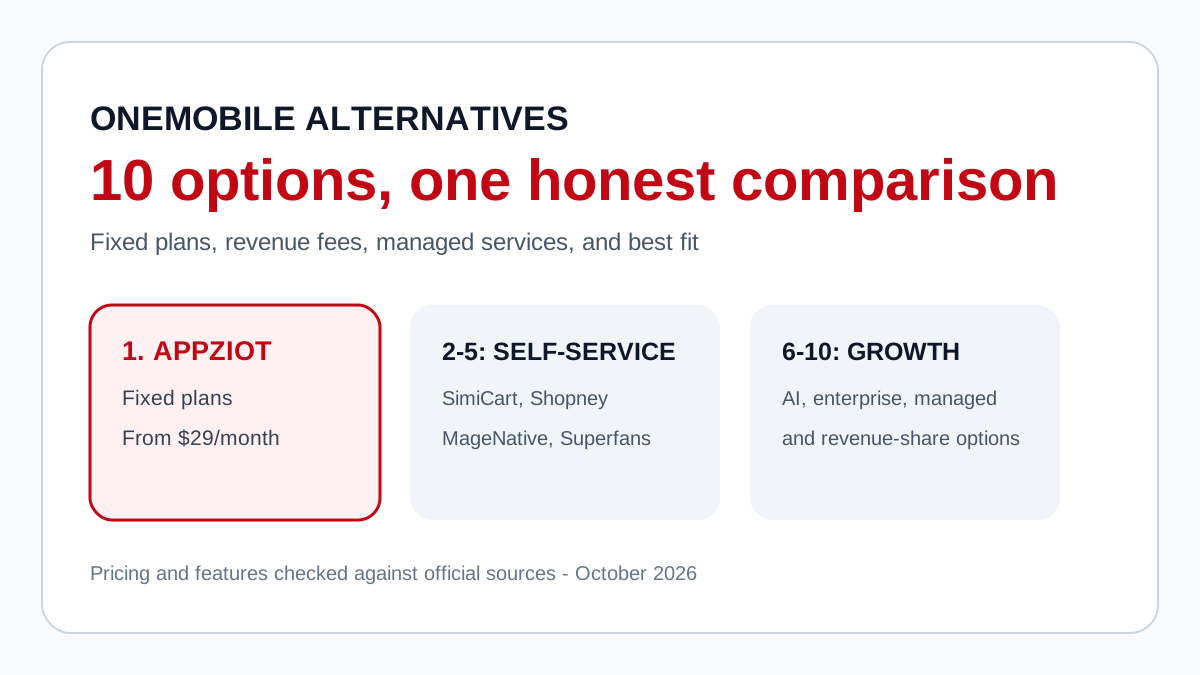
Appziot is the first OneMobile alternative to consider for a low fixed subscription. SimiCart and MageNative offer predictable mid-priced plans, Shopney emphasizes integrations, Superfans community, and Appbrew or Tapcart growth tooling. Plobal retains variable pricing, while MobiLoud and Venn provide managed services.
OneMobile is easy to try. It offers a free builder, AI-assisted design, and paid plans that add push automation, localization, shoppable video, and implementation help. The part that deserves closer attention is the bill after launch: paid plans add an infrastructure fee when app revenue crosses a threshold.
That pricing can still work well. A merchant may prefer a low initial subscription and accept a variable charge once the app earns money. Other teams want a fixed bill, their own developer accounts, a larger integration catalog, or a more managed service. Those are the reasons to compare alternatives.
Disclosure: Appziot publishes this article and appears first. This is not an independent ranking. Appziot has a lower fixed starting price than most products here, but it also has a shorter public track record and a smaller documented integration catalog than several established providers. We did not independently performance-test these apps.
Pricing and product details were checked against official vendor pages and Shopify App Store listings on October 14, 2026. Confirm final terms directly with each vendor.
OneMobile pricing and the decision it creates
OneMobile lists a Free plan, ScaleUp at $99 per month, BrandUp at $299, and Omni at $990. Paid plans have a 14-day trial.
ScaleUp adds a 2.9% infrastructure fee after monthly app revenue exceeds $2,000. BrandUp lists 1.9% after $10,000, and Omni lists 1.2% after $100,000. Published caps apply, but the calculation language varies across OneMobile’s public pages. Ask for an example using your expected app revenue.
Its terms also discuss shared Apple and Google developer accounts as a temporary option and recommend merchant-owned accounts. Listing ownership and transfer terms should be part of the purchase decision, not an afterthought.
The top 10 alternatives
| Alternative | Published starting price | Pricing style | Best fit |
|---|---|---|---|
| Appziot | $29/month | Fixed plans | Lower-cost native app launch |
| SimiCart | $99/month to publish | Fixed plans | DIY teams wanting unlimited push |
| Shopney | $149/month | Fixed plans | Broad Shopify integrations |
| MageNative | $99/month | Fixed plans | International and feature-rich stores |
| Superfans | $150/month on Shopify listing | Fixed plans | Community and retention programs |
| Appbrew | From $199/month | Subscription plus possible performance charges | AI-led growth teams |
| Plobal Apps | Free to install plus 3% of sales | Subscription or revenue share | Low-upfront-cost launch |
| Tapcart | $500/month | Premium tiered plans and add-ons | Advanced optimization teams |
| MobiLoud | $1,499/month plus setup | Managed service | Preserve an existing web stack |
| Venn Apps | From $1,999/month | Managed fixed-price plans | Bespoke Shopify Plus apps |
1. Appziot: best for a low fixed-price start
Appziot costs $29 per month or $290 per year for Lite, $99 per month or $990 per year for Starter, and $199 per month or $1,990 per year for Growth. All three plans have a 30-day trial.
Lite covers native iOS and Android apps, branding, catalog and inventory sync, and analytics. Starter adds the visual builder and push notifications. Growth adds richer push options, more widgets, branding removal, and priority support.
Why choose it over OneMobile: The public plans use fixed subscription prices rather than a percentage tied to app revenue. Starter matches OneMobile ScaleUp’s base price while avoiding OneMobile’s published infrastructure-fee formula.
Where OneMobile is stronger: OneMobile publishes a free design path, AI campaign tools, shoppable video, voice and barcode search, and broader assisted-publishing options. Appziot’s documented integration catalog is smaller.
See Appziot pricing and available integrations.
2. SimiCart: best for DIY publishing with unlimited push
SimiCart has a free build-and-preview plan. Publishing starts with Basic at $99 per month, followed by Pro at $149 and Premium at $249. Paid plans include a 14-day trial, and SimiCart states that it does not charge a success fee.
Basic includes iOS and Android publishing and unlimited push. Higher plans add loyalty, app-exclusive discounts, more design help, and a dedicated success manager.
Best fit: A small team that wants predictable pricing, real-device previews, and unlimited push without a revenue-linked bill.
Trade-off: The free tier is for building and previewing, not publishing. Design support and higher-touch service require Premium.
3. Shopney: best for a broad integration ecosystem
Shopney starts at $149 per month for Silver. Gold is $299, Platinum is $599, and Enterprise starts at $1,299. It offers a 30-day trial and states that it does not take a commission on sales.
Silver includes unlimited push, in-app chat, and back-in-stock messaging. Gold introduces more search, review, and localization integrations. Platinum adds loyalty, subscriptions, segmented push, AR, live selling, Klaviyo, Rebuy, and Nosto.
Best fit: An established Shopify merchant whose reviews, loyalty, subscription, search, or marketing stack must work inside the app.
Trade-off: Many integrations that make Shopney attractive sit on Gold or Platinum, so the relevant price may be much higher than Silver.
4. MageNative: best for international commerce features
MageNative lists Starter at $99 per month, Standard at $149, and Premium at $249, with a 30-day trial and 0% success fee.
Standard adds multilingual and multicurrency support, automated notifications, landing pages, and a success manager. Premium adds unlimited and segmented push, advanced analytics, AR, Shop Pay, and custom fonts.
Best fit: Merchants that need localization and a broad feature ladder but still want a conventional fixed subscription.
Trade-off: Starter permits only five instant push notifications per month. Some older MageNative pages show obsolete prices, so use the current canonical pricing page.
5. Superfans: best for community and loyalty programs
Superfans, formerly Vajro, is positioned around app-only drops, community feeds, shoppable user-generated content, games, polls, live selling, and retention. Shopify lists Starter at $150 per month and Unlimited at $1,000 per month or $10,000 per year.
Best fit: A brand with an actual content and community program—not simply a store that wants push notifications.
Trade-off: The jump between the public tiers is large, and Superfans’ own pricing page emphasizes Unlimited while Shopify still lists Starter. Confirm current availability and scope.
6. Appbrew: best for AI-assisted mobile growth
Appbrew lists Starter from $199 per month, Pro from $599, and Enterprise from $1,099 on Shopify, although its own site describes Enterprise as custom-priced. It offers a 30-day trial.
Its product emphasizes the Milo AI assistant, native video, personalization, gifting, bundles, analytics, and A/B testing on higher plans.
Best fit: A growth team that wants AI assistance and experimentation built into app operations.
Trade-off: Starter and Pro may carry additional performance-based charges, but no universal public formula is provided. Ask for the calculation in writing.
7. Plobal Apps: best for a revenue-share entry route
Plobal Apps has a Starter option that is free to install and charges 3% of total in-app sales. Growth is $199 per month, Essential is $499, and Enterprise is $1,199. Its public pages show revenue-share terms on some tiers.
The platform includes native apps, push notifications, analytics, personalization, Apple Pay, and progressively more integrations.
Best fit: A merchant that prefers a minimal upfront subscription and is comfortable paying more as app sales grow.
Trade-off: Revenue share can become more expensive than a fixed subscription. Ask for a worked first-year example, including integrations and professional services.
8. Tapcart: best for mature experimentation
Tapcart lists Growth at $500 per month, Scale at $1,250, and Enterprise+ from $2,850. Scale adds A/B testing, conditional content, targeting, heatmaps, and advanced analytics. Enterprise+ adds developer tooling, regional apps, dedicated infrastructure, and a published SLA.
Best fit: A larger brand with the traffic and staff to run continuous mobile experiments.
Trade-off: It has a high entry price, AI is shown as an additional $250 per month, and public pages indicate other charges may apply. Request an all-in quote.
9. MobiLoud: best for keeping the existing web experience
MobiLoud is different from a drag-and-drop Shopify app builder. It converts and manages an existing web experience as mobile apps, preserving more of the current storefront and third-party stack.
Its Business service is listed at $1,499 per month, or an effective $1,274 per month annually, plus a $5,000 setup fee. It includes 10,000 monthly active users, with overages after that.
Best fit: An established store with a complex existing website that wants managed implementation instead of rebuilding screens in a new editor.
Trade-off: It is a high-cost managed service with setup and usage costs. The free MobiLoud Shopify listing is a companion push app, not the full app-building service.
10. Venn Apps: best for a bespoke managed program
Venn Apps lists Pro from $1,999 per month and Enterprise from $2,999, with a 30-day trial. The service includes dedicated design, managed delivery, standard integrations, push, and a CMS. Enterprise adds custom modules, expansion stores, localization, and more advanced loyalty work.
Best fit: A Shopify Plus or global brand that wants a highly customized, white-glove mobile program.
Trade-off: This is the highest starting price in the list. Confirm the final statement of work and any external charges.
How to choose between fixed and variable pricing
A revenue-linked plan is not automatically bad. It can lower the risk before the app produces sales. The problem is comparing only the subscription line.
Model three scenarios: the first quiet month, a normal month, and your strongest seasonal month. Include the platform fee, revenue or performance charges, integrations, setup, design services, Apple and Google accounts, and any monthly-active-user overages.
Then test the operational fit. Have the person who will run the app build a home screen, publish a collection, schedule a push, and find a performance report. A pricing model only matters if the team can use the product consistently.
Our verdict
Appziot is the strongest fit when the priority is a low fixed subscription and core native Shopify functionality. SimiCart and MageNative provide broader fixed-price feature ladders. Shopney is stronger for integrations, Superfans for community, and Appbrew or Tapcart for growth tooling. Plobal and OneMobile make variable fees part of the trade. MobiLoud and Venn serve merchants seeking a managed, higher-budget program.
Sources
Frequently asked questions
What is the best fixed-price alternative to OneMobile?
Appziot, SimiCart, Shopney, and MageNative publish conventional fixed subscription tiers without OneMobile’s infrastructure-fee model. The best option depends on integrations and plan features, not only the starting price.
Does OneMobile charge a percentage of app sales?
OneMobile’s paid plans publish infrastructure fees after monthly app revenue crosses a plan-specific threshold. Confirm the exact calculation and cap in writing because wording differs across its public pages.
Can I publish a OneMobile app for free?
OneMobile markets a free route, but its public pages differ on what can be published and whose developer accounts are used. Confirm the live-store scope, listing ownership, and transfer terms before relying on a $0 launch.
Which OneMobile alternative is best for a large Shopify brand?
Tapcart is suited to advanced experimentation, Venn Apps to bespoke managed delivery, and MobiLoud to preserving a complex existing web stack. Each costs substantially more than self-service builders.